SIEM stands for Security Information and Event Management. It is a security solution for companies' digital infrastructures. A SIEM system provides companies with a central platform for monitoring, analyzing and reacting to security events in their IT.
The main goal of SIEM is to detect potential detect and mitigate potential cyber threats at an early stagebefore they disrupt business operations and cause massive damage. SIEM therefore plays a crucial role in improving the security situation of companies.
In addition, many companies that are subject to the NIS 2 Directive must use SIEM to comply with legal regulations. SIEM systems can generate reports that demonstrate compliance with security standards and regulations.
In a nutshell, the basic function of SIEM is to collect all data relevant to IT security in a central location and analyze it for patterns that indicate potential threats. If such a pattern is detected, an appropriate response can be initiated.
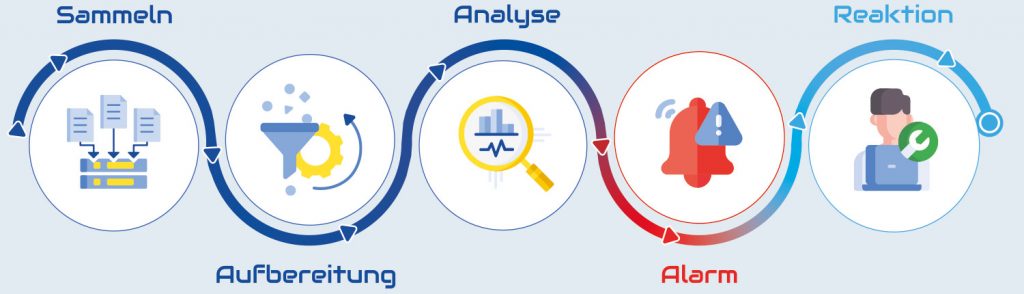
A SIEM system therefore has three important core functions:
Log data from various sources in a company's IT infrastructure is collected and stored in a central location. This makes it easy to analyze and correlate events. Log management is a fundamental aspect of SIEM and helps companies to meet compliance requirements.
SIEM systems use algorithms to analyze and correlate data from different sources. This allows patterns or anomalies that could indicate a security incident to be detected - in real time. This correlation is important to distinguish normal network activity from potentially malicious activity.
When a potential security incident is detected, SIEM systems provide tools for incident response and investigation. These include features such as alerts, dashboards and forensic analysis tools to help security teams understand the nature of the incident and take appropriate action.
Think of your IT network as your body and the SIEM system as your personal health monitor. The SIEM system continuously monitors the vital signs of your digital "body" by checking various parameters such as heart rate (network traffic), temperature (system activity) and more.
Similar to a health monitor that alerts you when your heart rate increases, the SIEM system alerts IT experts when unusual activity or potential threats occur.
When a health problem is detected, you go to the doctor. When a security incident occurs, IT experts use the SIEM data to diagnose and treat the problem.
SIEM is used for various important purposes in the field of cyber security:
SIEM systems actively monitor the company's IT environment for signs of security threats and attacks. They are able to quickly detect and respond to suspicious activity in order to minimize potential damage.
When a security incident occurs, a SIEM system provides detailed logs and information for the investigation. It helps security teams understand the scope and nature of the incident, enabling a faster and more effective response.
Many industries and organizations must adhere to certain regulations and compliance standards, especially critical infrastructure operators. SIEM helps by providing the necessary tools to generate reports and demonstrate compliance with security policies.
Ensuring IT security can be a major challenge, especially in complex IT environments or due to a lack of resources. A SIEM provides a central platform for security management, making it easier to monitor and control security measures.
By analyzing patterns and trends in security data, SIEM can contribute to risk management strategies. Companies can better understand their security posture, identify potential vulnerabilities and take proactive measures to address them.
SIEM is therefore an important tool for companies that want to improve their cyber security. It helps with threat detection, incident response, compliance and overall security management and provides a comprehensive solution for protecting digital assets and sensitive information.
In a world of increasing cyber threats, a SIEM is essential for maintaining a secure IT infrastructure for several reasons:
A SIEM system actively monitors the IT environment in real time, enabling the early detection of abnormal or suspicious activity. This timely detection is crucial for identifying potential security incidents before they escalate.
A SIEM system enables a rapid response to incidents by alerting security teams to potential threats and automating certain response actions. This helps companies to mitigate the impact of security incidents and prevent further damage.
SIEM systems provide a comprehensive overview by collecting and analyzing logs from various sources. This transparency is essential for understanding the overall security situation of a company.
A SIEM system helps to meet these requirements by providing tools for log management, reporting and proof of compliance with security policies. This is crucial to avoid legal consequences and maintain the trust of all parties involved.
From a business or corporate perspective, SIEM offers several benefits and contributes to the overall cybersecurity and operational efficiency of organizations. Here are the main benefits:
SIEM systems help maintain business operations by minimizing the impact of security incidents. Ensuring uninterrupted business operations is critical to customer satisfaction, revenue generation and overall business sustainability.
SIEM systems help with regulatory compliance by providing tools for log management and compliance reporting. Ensuring compliance with industry regulations and standards helps to avoid legal consequences, fines and sanctions and promotes a trustworthy and legally compliant business environment.
A rapid response to security incidents minimizes their consequences. This can reduce potential financial losses and business interruptions.
A good reputation for security and trustworthiness strengthens customer confidence, attracts business partners and positively influences stakeholder perception. Implementing a SIEM system demonstrates the company's commitment to cyber security and due diligence.
SIEM automates routine security tasks, freeing up human resources for strategic activities. Optimizing resources allows the company to focus more on innovation, growth and other core activities, which improves overall competitiveness.
A SIEM system therefore offers tangible benefits by reducing risk, ensuring compliance and contributing to the overall security and resilience of the organization. It is in line with overall business objectives and supports sustainable growth and success.
In summary, a SIEM system is essential for a secure IT infrastructure in the face of increasing cyber threats. It provides early detection, rapid response, a comprehensive overview and helpful tools for compliance. Only in this way can companies stay one step ahead of the increasing challenges in the area of cyber security.
IT security is now more crucial than ever as digital technologies take a central place in our society and economy. But what exactly is the NIS 2 directive and what does it mean for your company?
In this article, we provide you with a comprehensive overview of data protection - from legal principles to specific measures that companies can take to ensure the security of personal data.
After all, the importance of data security goes far beyond the technical aspect. In this article, we explain what exactly data security is, why data security is important and which legal regulations apply to companies in Germany.